Collection
弈墨 Chinese Go Game Classics: Yi Mo
Yi Mo: a book printed four hundred years ago. A hundred Go game records, played in China's Jiangnan region between the fall of the Ming and the rise of the Qing. In the China of that time a game of Go began with four stones already on the board, and White made the first move: the same rules, but an opening setup abandoned a century ago.
Some books tell a story; Yi Mo whispers an era...
Yi Mo (弈墨, roughly “Go Ink” or “Model Games”) is the title of a book that gathers a hundred game records played between rival Go masters in Jiangnan, a wealthy region whose cities were linked to one another by waterways, during the bloody years of transition between the fall of the Ming dynasty and the rise of the Qing.
Those years saw one of the harshest ruptures in Chinese history. In 1644 peasant rebellions reached Beijing, the last Ming emperor hanged himself, and the Manchus from the north took the throne. A year later the rich canal cities of the south, where these games were played, fell as well. Most of the masters in this book were sitting at the Go board in exactly those years, in exactly that place.
The book was compiled by Li Zixie, a Go enthusiast from Huai'an. From the more than six hundred games he had gathered, a hundred were selected and annotated by Ji Xinxue, one of the leading players of the day. The work was completed at the very start of the Kangxi era, around 1662. Wang Xie, who wrote its preface, describes the crowded ranks of Go masters of those days like this: the masters vied with one another for supremacy, and the games they piled up numbered more than a thousand; dozens of the country's great players shuttled back and forth between the Yangtze and the Huai.
These masters had neither court salaries nor tournament prizes. Their living depended on the wagers placed by the high officials, rich merchants and upper-class men of letters who watched them play. Chinese has a saying for this: 靠天吃饭 (kao tian chi fan), “eating by looking to the sky.” It is really said of the peasant with no irrigation, whose field is left to the mercy of the rain: the labour is yours, the harvest is not.
It was the same for the masters. In times of peace, courtiers and merchants spent time and money on Go and the players lived comfortably; when the country was shaken or at war, patronage dried up and the tables emptied, and, just as today, only the rich ate their fill while genius was lost in poverty. The hundred game records of Yi Mo are a frozen snapshot of those geniuses at their most brilliant.
The book's own history is a story in itself. Yi Mo was printed in 1662 and not printed again for three hundred years. By the early years of the People's Republic it had become hard to find. The Beijing Library held a copy, but it was lost during the Cultural Revolution. The only reason we have the book today is that in the early 1960s the archive of the Shanghai Go Club had the entire text copied out by hand. In other words, the one surviving copy is not a printed edition but a transcript that someone sat down and wrote out line by line.
In 2004 a special twenty-four-volume collection of China's ancient Go books, prepared by the Chinese professionals Chen Zude and Wang Runan, was published, and Yi Mo was reprinted there in two volumes. Put differently, what we lost was not the voice of Yi Mo but the object that once made that voice possible.
This book should not be seen as a mere dry list of game records. Before Yi Mo, Chinese Go books consisted mostly of corner and life-and-death diagrams; complete records, with the names of both players and every move from the first to the last along with the winner, were rare. That is why Yi Mo is regarded as the first large-scale collection of real games in Chinese history, and why it opens the door to the golden age of Qing Go.
The proud veteran and the quiet boy
At the centre of the collection stands the greatest master of the Ming, Guo Bailing (1587–1660). Born into an old, established family of the city of Wuxi, this boy watched his elders play at the age of eleven, declared that there was nothing difficult about it, and soon became the legend of the town.
In the autumn of 1651 the celebrated poet and statesman Qian Qianyi, passing through Zhenjiang, watched a game of Go and wrote six quatrains in a row. The second of the six is traditionally read as a portrait of Guo Bailing:
At eight, his milk teeth not yet shed, he stepped into the arena of Go;
Qian Qianyi, “Six Quatrains on Watching Go at Jingkou”, no. 2
now his hair is white — whose hand would dare to reach for his banner?
Year after year he has laid out every old record on the board anew —
yet only when the game is over does one learn how hard it is to judge its course.
One of the most remarkable episodes connected with the book takes place in the capital, Beijing. Lin Fuqing, the most respected senior master of the day, haughtily challenges the young Guo in front of noble gentlemen, and silver is put up as the prize. Guo declines again and again, politely, but when he can refuse no longer he sits down and beats Lin in three games in a row. Lin, it is said, turned red and then pale.
The story matters, because the first ten records in Yi Mo are precisely between Guo Bailing and Lin Fuqing: the book opens with the clash between the pride of the old generation and a rising genius. Lin's era is described as a stage in which every local fight on the board was played out on its own, before whole-board strategy had been born. Guo's innovation was the idea that the board could be thought of as a single whole.
Here are the ten records of games played between Guo Bailing and Lin Fuqing:
Today, since 2017, the Guo Bailing Cup has been held every year in Wuxi's Xishan district. It is now one of China's top national amateur Go tournaments. Its format is no accident either: the winner of the open section challenges the previous year's title holder in a best-of-three match. In other words, the stage set in Beijing four hundred years ago has become a tournament rule in the great player's homeland. Surely one of the most prestigious tournaments that we amateurs could enter in East Asia!
But back to history. Lin was not the only contemporary the young Guo faced across the board. Xu Jingzhong, one of the last masters of the Ming, appears in the opening pages of the collection as an opponent of Guo and of others. Xu Jingzhong's name hardly ever appears in Western literature today. Almost everything known about him comes down to the games of his preserved in this book.
Here are four records of Xu Jingzhong's games:
In his old age Guo Bailing opened a qifang, a Go school, in his hometown of Wuxi and trained students. He was not only a player but also a theorist: he left behind the written works Guanzi Pu (The Endgame Book), Sanzi Pu (The Three-Stone Handicap Book) and Sizi Pu (The Four-Stone Handicap Book). From his family line came Guo Xuchu and Guo Tisheng (the teacher of Nie Weiping, who also helped found Beijing's Go association).
One family, three hundred years!
A country boy of twenty
Forty years later the scene repeats itself in another form, but this time it is Guo Bailing who loses. Zhou Lanyu (~1630–?) is the son of a poor family from the town of Meili in Jiaxing. His family pushes him first towards study, then towards trade; he slips away in secret to play Go. They try to stop him, in vain. He bets against his opponents, wins time after time and comes home at night laden with money, whereupon his family lifts the ban.
When the two meet in Hangzhou in 1644, Zhou, just twenty years old, plays nineteen recorded games against Guo Bailing, by then past sixty. The winner is known in twelve of them, and Zhou won nine: the banner of the Go world changes hands.
His contemporary Zhou Yun sums up his secret in a single sentence: “If you look into why he wins, it is that once he has taken sente he never lets it go.” His own rule is sharper still: “Be willing to give up a few stones, but never lose a single sente.”
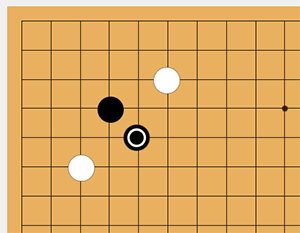
Zhou Lanyu also left a lasting mark on the board. When an opponent approaches a corner stone from both sides at once, the move known in Go literature as shuangfeiyan, “the two swallows”, how to answer it was a matter of debate at the time. A generation later Xu Xingyou writes: “Against the two swallows, press on top of both stones; this way of playing begins with Lanyu, and it is the cleanest.”
That answer is still played today.
Four sample records of games between Zhou Lanyu and Guo Bailing:
Zhou's rise drew another enthusiast into what was practically a laboratory. Li Yuanzhao studied, one by one, the games Guo Bailing had lost to Zhou, made a diagnosis, then went straight to Jiaxing and played ten games with Zhou: he won six. His diagnosis was this: “Zhou shies away from open-field fighting; so I beat him with open-field fighting.”
A generation later the master Xu Xingyou would write that this explanation was not entirely accurate. But what Li did was, in the fullest sense, to find a player's weakness in the games others had lost to him, which, when you think about it, is exactly what we still do today.
The ascetic on the mountain
A monk also wanders through the pages of the collection: Ye Xue (1573–1644), from Yongjia county in Zhejiang. He had become a monk at Guoqing Monastery on Mount Tiantai. His contemporary Feng Yuanzhong refers to him simply as “Zheng Yexue, the monk of Yongjia”; the travelling writer Xie Zhaozhe calls him “Zheng the Ascetic of Yongjia”. The word he uses comes from the Sanskrit dhūta and literally means “shaking off”: cleansing the mind of dust by clinging to nothing in clothing, food or shelter. In China it came, over time, to describe monks who wandered on foot and lived by begging. That was exactly Ye Xue's life: devoting himself entirely to Go, he roamed from city to city, and wherever he heard a master's name, he went and sat down across the board from him.
In 1605 Ye Xue took part in a nationwide tournament held in Nanjing. After toppling several guoshou, players holding the title of “national master”, he lost to Wang Yuansuo. He was the last great representative of the Yongjia school, one of the three great Go schools of the Ming. Today this monk is the only player from a whole school, from a whole city's Go history, whose game records survive.
The Tiger and the Dragon — the merchant masters of Huizhou
The Go schools of the Ming were rivals, and each was the product of a different geography. If Ye Xue's Yongjia drew its strength from monasteries and mountain towns, the Huizhou school came from the very opposite: the cities of Anhui grown rich on the salt trade. These salt merchants supported Go players just as they supported painters and calligraphers.
In the second half of Yi Mo the men of this school fill the stage. Wang Hannian, who was also a painter, is one of the players with the most game records in the collection. Another is Wang Youqing, ranked in the classification of the day as a mingjia, a master just below the first rank.
They are joined by Sheng Dayou and Zhou Donghou of Suzhou. Zhou Donghou plays twenty-five games in the Yile Garden in Yangzhou against the greatest genius of the Qing, Huang Longshi, the “dragon” (long is Chinese for “dragon”). Huang prevails with 16 wins, 8 losses and 1 draw. On paper that is a crushing superiority, yet no one else came anywhere near the eight wins Zhou took from Huang. That is why Zhou Donghou's nickname is “tiger”.
The editor who signed his own book
And one last detail. Ji Xinxue, who selected the games, put them in order and annotated their margins, was not just an editor: he was a player himself. Towards the last pages of the collection he included his own games too. Among the masters he had compiled, on the same board, ready to be judged.
Four sample games:
The ancient masters measured against today
I suspect we are all curious how strong the ancient masters named here would be by today's standards. The Chinese call this kind of comparison “making heroes of two different eras fight”, or, more specifically, “making Guan Yu fight Qin Qiong.”
One of the first to take the question seriously was the greatest master of the twentieth century, the China-born Go Seigen. Go Seigen worked through the Guanzi Pu attributed to Guo Bailing from beginning to end and published it in Tokyo in four volumes in 1977–78: one thousand four hundred and seventy-eight problems, each examined one by one. In Michael Redmond's words, “Go Seigen, who came from China and became one of Japan's top players, studied the Go of ancient China and learned its essence; that was the secret of his strength.”
Go Seigen's verdict was clear: the strength of the great masters of the Qing, in his own words, “had reached a truly remarkable level; it must correspond to that of a Japanese meijin.” Meijin was Japan's highest title, so this was the highest praise a master of the Japanese Go world could give.
The same judgement is still being made today. In the same text Redmond writes: “The fighting strength and depth of reading of the ancient Chinese players are of a kind that even modern players would find hard to surpass. We need to study the ‘fighting Go’ of ancient China all over again.”
Fortunately, AI has now reached the point where it can give us somewhat clearer answers: because KataGo is the only major engine that supports China's zuozi and huanqitou rules, the ancient game records can for the first time be measured by their own rules.
The most serious example of such measurement is the statistical study published in 2021 by the professional Go player Cui Can. The result is striking: Huang Longshi, Fan Xiping and Shi Xiangxia come close to today's best professionals in the middle game, but fall behind in the opening. Cui Can's data refute the claim that “the ancient masters were really only as good as a strong amateur”; but, to be honest, they give no rank figure either. That rigour matters. Most of the precise figures circulating online, such as “so many Elo points” or “an AI would give them two stones”, rest neither on a method nor on a counted set of games.
In the case of Yi Mo, an AI has actually been put to work on a real survey. For in most of these games it is not known who won: the book recorded the moves but not the result. The final position of each of the hundred games was counted by an AI and the winners determined: White won 59, Black 32, and in nine the margin was small enough to fall within the counting error. Whether White's large lead stems from the many games in which the stronger masters held White is hard to say, but it inevitably brings the first-move advantage to mind. (Remember that when these games were played, there was no komi yet.)
The same survey also covers the ten games that open the book, and gives an unexpected result: Lin Fuqing leads Guo Bailing six to four. So the old master who suffered three defeats in a row in Beijing was, it seems, ahead over the recorded games as a whole. Perhaps that famous three-game challenge in Beijing does not tell the whole story between the two?
Still, every AI verdict must be read with caution. Because the four stones in the corners narrow the scope for opening mistakes, the AI's evaluation may give the ancient masters a systematic advantage, something Cui Can himself acknowledges.
Of course, there would be little point in squeezing all hundred games of the book into this article. But the entire collection is on Kifu Master. Just search for the master you are curious about by name. And there we leave it.
@2026/09/19